Scouting Report: Leo De Vries and the Shape of an A’s Franchise Shortstop
By Riley Thompson ·
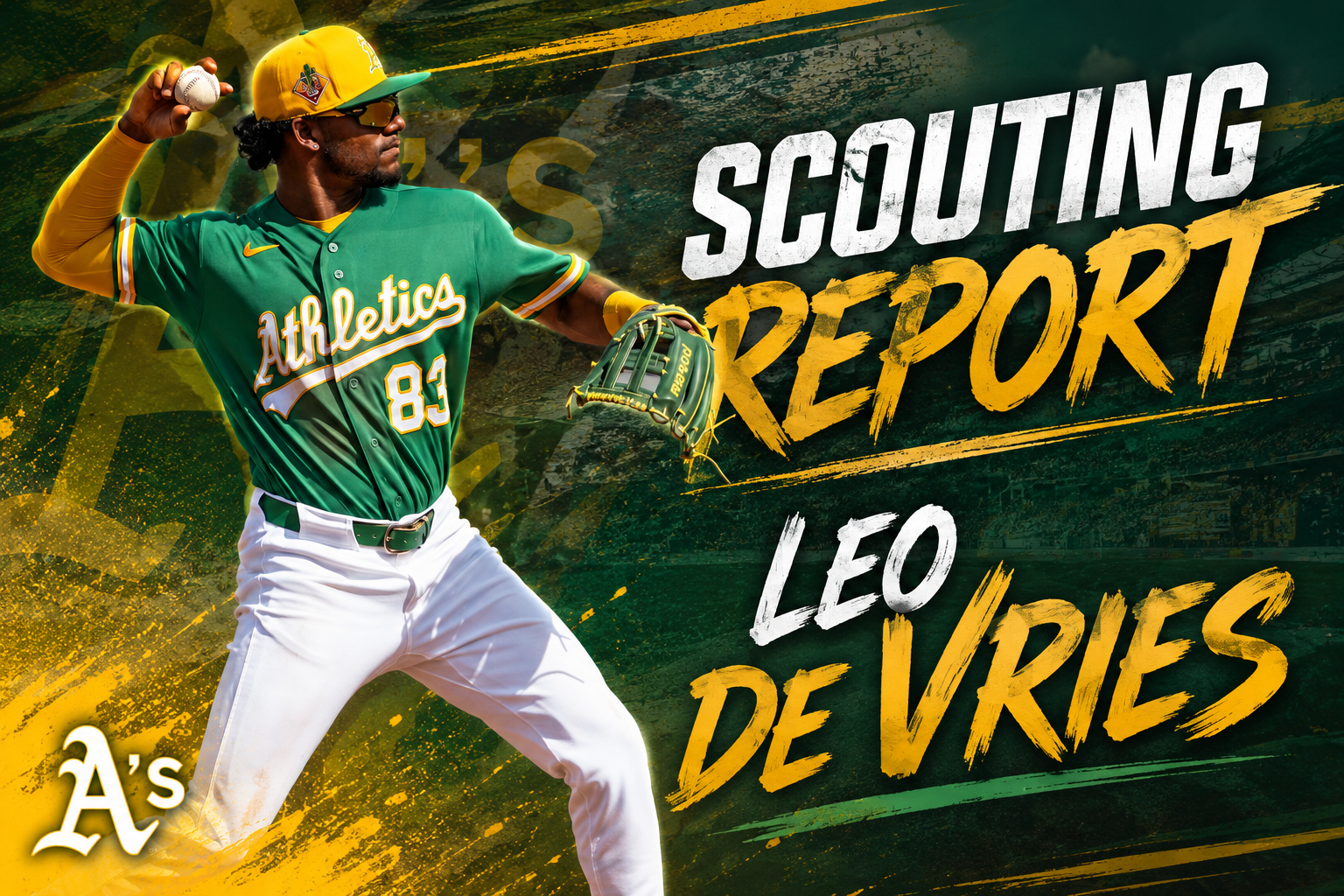
Amateur Track Record, Trade Story, And Rapid Prospect Ascent
Leo De Vries reached the Athletics’ system as a global shortstop headliner, a switch-hitting teenager whose international pedigree already carried everyday shortstop expectations before he ever took a pro at-bat for Oakland. The Mason Miller trade moved him from “high-end young infielder” into the de facto return for a power-armed big leaguer, immediately placing internal pressure on the profile to hold up as a future roster pillar in a new market.
Since that deal, his trajectory has matched the price. The industry moved him into the consensus top tier of global prospects inside 12 months, and most club-level internal boards now treat him as a 1A/1B type in the under-21 group rather than a simple “top-50 name.” The path has been aggressive: complex ball to full-season, then up the ladder into Double-A by age 19, with performance driving the pushes. Where his early reports read as projection-heavy, the Oakland phase has added concrete gains in bat speed, strength, and defensive polish that have pushed his card closer to “future 60 shortstop, chance for 70 bat at peak” than the more modest 55/55 outcomes scouts floated when he first signed.
The Mason Miller trade framed the organizational bet: move a volatile, high-octane arm for a young middle-of-the-diamond switch-hitter who could anchor the Las Vegas core. De Vries’ rapid climb into Double-A lineups at 19, and the way his tools have ticked up under Oakland’s development, now give that bet a realistic path to paying out at the top end of the scale.
Physical Build, Athleticism, And Strength Projection
De Vries carries a modern shortstop build: lean but strong, high-waisted with good proportions, and enough twitch to separate him from the “big body that has to move off the dirt” archetype. The frame can support added good weight through the shoulders and hips without compromising first-step quickness, and the last year has already featured visible strength gains in his forearms and lower half, reflected in harder contact off the barrel rather than bulk for its own sake.
He moves like an up-the-middle athlete rather than a corner-infield bat, with fluid lateral movement and balance on pivots, plus the coordination to handle body-control plays on the move. In Oakland’s environment, the physical trajectory has been managed toward functional strength: more carry off the bat and more firm throws across the diamond, but no attempt to turn him into a maxed-out slugger. That approach protects his middle-of-the-diamond viability while still leaving room for the raw power grade to climb into the 60 band as he finishes filling out.
Double-A Performance At 19: What The Line Tells Us
The noise in any teenage Double-A line is real, yet the signal in De Vries’ case is strong: contact rates that sit comfortably playable against upper-level velocity, walk totals that reflect mature strike-zone awareness, and isolated power trending upward as he learns which pitches he can truly turn around. He is young-for-level every night and still posting production that would be acceptable for a 23-year-old shortstop, which shifts the evaluation from “nice early arrival” to “genuine impact trajectory.”
The batted-ball profile in Double-A has moved from pure line-drive to hybrid damage: more air contact to the pull side, maintained line drives in the middle of the field, and enough opposite-field contact to avoid becoming easy to game-plan. His ground-ball share remains manageable, and the growing slugging percentage is driven more by extra-base volume than a handful of outlier home runs, which scouts favor as evidence that the gains in strength and swing intent are sustainable rather than small-sample noise.
Switch-Hit Offensive Package: Left-Side Swing
Setup and move: From the left side, De Vries hits with a slightly open base, relaxed handset near the back shoulder, and a controlled leg lift that lets him load into his back hip without drifting. The stride is direct, the head stays quiet, and the sequence from gather to launch is clean enough that evaluators now use “advanced timing for 19” as a baseline descriptor.
Path and bat speed: The left-handed swing carries above-average bat speed with a direct path that enters the zone on a slightly uphill angle. He stays inside the ball well, which allows firm contact to left-center and keeps him from becoming purely pull-happy. When he wants damage, he can get the barrel out front and create loft to his pull side without collapsing his backside, an adjustment that has tightened under Oakland’s hitting group and is tied to his recent jump in extra-base production.
Approach and contact quality: The left-side approach is plan-driven. He hunts fastballs in the top third and firm spin that starts in the zone, showing enough recognition to avoid gratuitous chase below the knees. His zone-contact rates are strong; he rarely looks overmatched against Double-A velocity. The main developmental note is selective aggression: he can still let driveable pitches go by early, working himself into more two-strike fights than he needs, but his ability to shorten up and spray contact in protect counts keeps the strikeout profile in a tolerable band. In scouting terms, the present left-side hit tool grades as a firm 55 with real probability to reach 60 as his timing and pitch selection in damage counts sharpen.
Game power from the left side: Current game power from the left box sits around a 50, with flashes higher. He is already living in the mid-teens home-run band on a full-season pace against Double-A arms, driven by a mix of pulled fly balls and hard line drives that carry out. The raw shows more: in BP, he can produce high-end exit velocities to the pull gap, and the recent trend in his swing decisions has been toward higher-impact contact without a spike in empty swings. As the body finishes filling and he continues to take advantage of favorable counts, the left-side power has a viable path into the 55–60 band, enough to project regular-sequence 20+ homer seasons even without playing in a hitter’s park.
Switch-Hit Offensive Package: Right-Side Swing
Setup and move: From the right side, the look is more compact and direct: slightly crouched stance, smaller leg lift, and a shorter gather into his back side. The move is tailored for timing and contact rather than pure impact, which fits his current role usage against left-handed pitching.
Path and bat speed: Bat speed from the right side is a shade lighter than from the left but still comfortably major-league average. The barrel works on a flatter path, prioritizing hard contact over loft. He can manipulate the barrel to different pitch shapes, and his hands stay inside the ball enough to keep him alive against left-handed breaking stuff, an area where many teenage switch-hitters lag.
Approach and contact quality: The right-side approach is more pragmatic. He will expand a little more against lefties in zone but does not show the wild chase rate you often see in developmental switch hitters. His contact rates are strong, strikeouts low, and the quality of contact is good enough to project consistent singles and doubles production even if the home-run output lags behind his left-side ceiling. Against advanced left-handed arms, his willingness to take pitches and ride the ball back through the middle fits the “switch-hitting table-setter” description A’s decision-makers have used when discussing his early role.
Game power from the right side: Right-side game power sits closer to fringe-average at present. He can punish mistakes, but most of his authoritative contact is line-drive rather than true lofted damage. Given his age and physical projection, there is still room for the right-handed power grade to climb into the solid-average band, but the realistic expectation is asymmetry: more thump from the left, more contact and matchup utility from the right. In aggregate, the switch-hit game power profile reads as present 50 with clear upside toward 55–60 as strength gains and refined swing decisions allow him to convert more of his raw into game output.
Underlying Approach, Contact Metrics, And Batted-Ball Profile
Under the hood, De Vries presents the statistical indicators you want in a teenage Double-A cornerstone candidate. His walk rate sits comfortably positive, not inflated by passivity, but tied to true zone control: he declines uncompetitive pitches early, manipulates counts into his favor, and shows a willingness to take free passes rather than forcing contact in disadvantage locations. His strikeout rate, while higher than his lower-level sample, remains in a band that supports a 55–60 hit projection once he gets out of his age-19 experiment phase.
The contact-quality metrics match the visual. Hard-hit percentage is climbing, and his average exit velocity has improved since joining Oakland, reflecting both physical maturity and better intent through the zone. He is already comfortable hitting with two strikes, maintaining enough bat-to-ball to avoid collapse in deep counts. The batted-ball mix shows a deliberate move away from early-career ground-ball heaviness: more fly ball and line-drive share, particularly to the pull gap, without sacrificing opposite-field contact. This pattern is exactly what front office and player-development groups look for in a young hitter pushing his raw power toward 60, because it points to sustainable swing decisions rather than wholesale mechanical overhaul.
Shortstop Defense: Footwork, Clock, Arm, And Range
Footwork and positioning: De Vries’ feet are light and organized. He sets up with good pre-pitch posture and shows consistent, efficient first steps both laterally and in on rollers. Oakland’s internal defensive work has focused on tightening his angles and reducing wasted movement, and the Double-A tape now shows a shortstop who arrives on time and under control far more often than he did in his pre-trade phase. On double plays, his pivot footwork is clean, and he transitions through the bag with middle-infield tempo rather than biggest-guy-on-the-dirt clunkiness.
Internal clock and decision-making: The internal clock already plays as a separator. He identifies runner speed quickly and calibrates tempo to the play, rarely getting caught between “rush” and “too casual.” That feel is particularly evident on slow choppers and backhand plays in the six-hole: he stays patient enough to secure the ball, then trusts his arm to finish the play. There are still occasional youthful lapses where he tries to do too much on low-probability chances, but the trend line points toward an above-average game clock once he has more upper-level reps.
Arm strength and accuracy: Arm strength grades solid-plus, with easy carry across the diamond and enough velocity to finish throws from deep in the hole. The uptick in physical strength since joining Oakland has added firmness to his throws without introducing wildness. Accuracy is already good; his miss pattern is largely to the chest rather than arm-side tail out of the bag. On the move, he can drop his slot and still keep the ball on-line, a trait that supports realistic everyday shortstop projection rather than a forced slide to third.
Range and defensive value: The range fits a modern shortstop: above-average both laterally and in shallow left, with enough speed to close on flares behind third and second when shifted. His first step and read quality matter more than raw sprint speed, and those elements look ahead of schedule. In scouting shorthand, his defensive package at shortstop now sits in the 55 band with a chance to tick toward 60 as reps and experience smooth out the remaining rough edges. That leaves Oakland with two credible long-term role options: above-average everyday SS or multi-position infield anchor who can move between short and other spots depending on roster needs.
Role, Timeline, And Fit In The Las Vegas Core
Role projection inside the A’s room has already shifted from “interesting teenager” to “planned everyday fixture in Las Vegas.” On an 80-grade scale, his current card reads like a 65 future value with positional scarcity leverage: a 60 hit, 55–60 game power switch-hitting bat and 55–60 shortstop glove at peak, with age and experience providing the remaining variance. That profile anchors the middle infield; it informs how Oakland will spend resources around him in their new market.
Timeline-wise, the Double-A assignment at 19 puts him on a reasonable track for a late-2027 or 2028 full-season arrival, with cups of coffee possible sooner if he either blitzes Triple-A or forces the issue with sustained upper-level dominance. Given the rebuild cycle and the Las Vegas move, front-office planners are already sketching lineups where De Vries handles short, a second athletic bat carries center field, and the corners are staffed with more traditional power profiles. His emergence allows them to lean into run prevention up the middle and invest heavier in bats and arms elsewhere without needing to overspend for a free-agent shortstop.
Realistic role outcomes fall into two bands:
Above-average everyday SS who hits in the top three spots of the order, drives 20–25 homers a year, controls the zone, and provides plus defense at short.
Multi-position infield anchor, splitting time between SS and 3B or 2B while still providing middle-of-lineup offense, if later physical changes nudge him slightly off the six.
From a scout’s chair, the early franchise cornerstone outcome now sits squarely on the table. De Vries has converted projection into performance at every step since joining Oakland, his tools have ticked up in the right directions, and his age-19 Double-A profile already checks the boxes clubs want in a player who can be the face of a new market window. The work left is incremental—tightening damage-zone aggression, letting the raw turn fully into 60 power, and refining defensive nuance—but the track is steep, and the ceiling fits the kind of shortstop you build Las Vegas lineups around for most of a decade.